

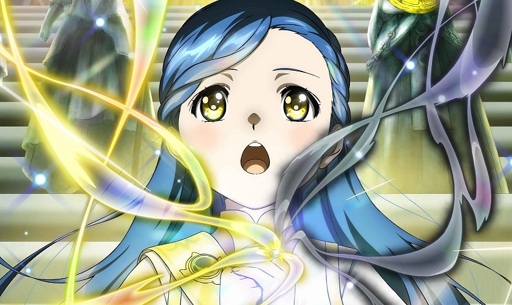
The fourth season of the Ascendance of a Bookworm anime, produced by WIT Studio, premiered on April 4 this year, though to an unexpectedly rocky start. The long-running series was faced with serious backlash after the reveal of the animated opening sequence, which viewers suspected featured AI-generated assets. In response to the criticism, WIT Studio posted an official announcement on April 10, in which it states that upon investigation into the opening’s production process, it confirmed that generative AI was involved. Consequently, the opening sequence recently published on YouTube has been removed from the platform. ……
The OP (Opening) is supposed to represent the best of the show, but sometimes it shows things not in the show or straight up misrepresents the show. The best example of this is Bradio’s Flyers from Death Parade, a macabre semi-anthology series about people competing in billiards games in a bar in Purgatory to determine which of them takes the elevator up and which one goes down. Or something like that. The show is very dark, but the OP is bright and cheerful.
I think anime’s bigger sin is the use of CGI. It’s very obvious in many cases. I don’t hate it, I just think it’s slightly more offensive than OPs that misrepresent the show (therefore, I don’t care about AI in them if they’re pretty). I’ll skip an OP I don’t like. Like in The Promised Neverland any time they run down hallways. It’s so obvious and distracting. Lots of animes do it, though.
The greatest sin in anime is the texture of clothing. This is most obvious in the Count of Monte Cristo anime due to the art style. Basically if a character is wearing a robe or some other clothing that has patterns on it, the patterns do not move with the person. The pattern is fixed, almost like there’s a layer of nothing but the pattern across the entire frame, and the outfit is just “transparent.” In fact, I think that is exactly how they do it. Almost how a lot of PlayStation games (Final Fantasy 7 and Resident Evil were notable for this), where you have a pre-rendered scene and the characters move across it within invisible walls which are supposed to, but do not always line up with what is drawn behind them.
Gankutsuou / Monte Cristo anime definitely uses it as a stylistic choice. It kinda gives it a stained glass look, where each “panel” has its own complex 2D pattern.
In general though it’s kinda a middle ground where you get characters who wear textured clothing more interesting than a single color without requiring a ton of time and effort to create. I can’t really bring myself to complain about it when it would take 10x the effort to make it look 1.5x as good (though I do appreciate it when they DO take the time and effort to make animated textured clothing)
I think it would be a bit more than 1.5x as good, but I don’t think 10x the effort is an exaggeration so it’s understandable.
You say that like it’s a bad thing, but the misdirect is the point.
It’s only a sin if done poorly, which admittedly is the case for many, but by now there are quite a lot that do a great job.
Why would you think this? Commercially, the opening is pure advertisement for the show and for the music in the opening. Artistically, they can do whatever the hell they want.
Almost no anime do this, what are you on about? It’s a deliberate choice of art style, nothing more. And either way, why would this be a “sin”?
They do though. The most common one is checkered/plaid clothing. There’s even a TV Tropes page on it. In some cases like Gankutsuou it’s stylistic, but it is often a shortcut. I don’t really have a problem with it though.
The TV Tropes page is about this technique is animation in general (and just because it exists does not mean it’s prevalent). They list at most 20 anime examples. That’s probably at most the number of shows I’ve seen with any kind of plaid at all.
I am not saying this technique does not exist in anime, or that Gankustuou is unique. I’m saying that this is not even close to “the greatest sin in anime”, and the VAST majority of shows use flatter color textures where this technique would not even be applicable.
You said “almost no anime”. 20 examples is already quite a lot and not exhaustive, some of them being pretty big names. That sounds pretty prevalent to me, even if it’s not the vast majority.
Oh that I totally agree with. I wouldn’t even call it a sin.
I think there’s just miscommunication about numbers here… if there are thousands if not tens of thousands of shows, I don’t consider 100 to be more than a drop in the bucket, let alone 20, and I don’t really care how “big name” a show is.
And again, I was saying all this is the context of OP’s “greatest sin in of anime”. Do I expect there to be more shows in the future that use this technique? Sure, but barring an art style fad for a year or two, I expect them to be few and far between. It just is not a technique that is at all indicative of what “anime” is or has been.
I’ve seen many anime do this. Chihayafuru comes to mind.
I dunno about that. I think it’s just much easier to render the clothing that way.
“Many” meaning how many though? I think there’s no way I (personally) could come up with 100 shows that have this aesthetic, and I wouldn’t consider 100 “many” in this context.
Gankutsuo, if that’s the one you’re talking about, was also a very early (possibly the first) use of the technique. I can forgive a pioneering show for getting things wrong. Its successors aren’t always as easy to forgive.
Much worse than messed-up clothing textures is the occasional show that puts a texture over the entire picture (the most blatant example I’ve ever seen used a watercolour paper type one, but damned if I can remember the name of the show), but binds it to the viewport rather than the background, so that when the camera pans or zooms, the texture moves with it and completely destroys the impression I think they were aiming for.